


Residents of Mexico’s Los Cabos resorts have rushed to prepare as Hurricane Norma headed towards the southern tip of the country’s Baja California Peninsula.
Businesses in Cabo San Lucas nailed up sheets of plywood over their windows, and government personnel hung up banners warning people not to try to cross gullies and stream beds after Norma regained strength and once again became a major storm on Friday.
By early Saturday, Norma had weakened slightly and was downgraded to Category 2 on the hurricane wind scale.
It was located 30 miles west-southwest of Cabo San Lucas with winds of 100mph and moving at 8mph, according to the US National Hurricane Centre.
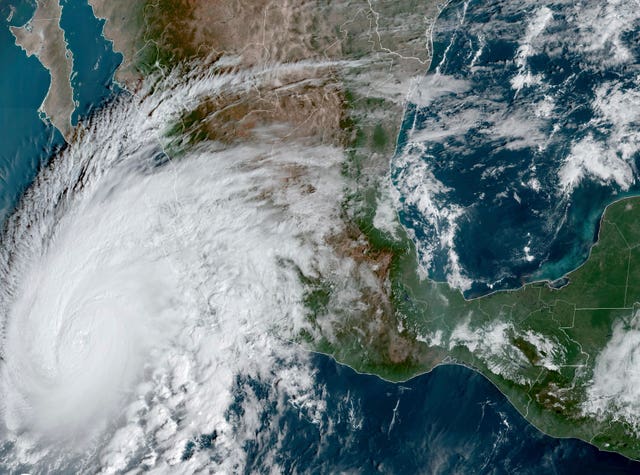
Norma was expected to continue on that path through the evening before turning to the north-east and slowing down through Monday.
The hurricane’s languid pace raised the possibility of severe flooding. Norma was expected to dump six to 12 inches of rain with a maximum of 18 inches in places across southern Baja California and much of the state of Sinaloa.
According to the national civil protection agency, shelters in Baja California housed some 1,500 people by Saturday morning.
The Los Cabos civil defence agency urged residents to stay indoors all day as winds and rain increased. Emergency workers rushed around the city evacuating people from low-lying areas and moving them to shelters.
Police in San Jose del Cabo rescued two people from their truck when a surging stream swept it away early Saturday.
Hotels in Los Cabos, which are largely frequented by foreign tourists, remained about three quarters full and there was no major move by visitors to leave, tourism official Maribel Collins said.
With rain already falling in Los Cabos, some flights in and out were cancelled on Friday, there was no way out anyway. Airports were closed on Saturday, according to the local civil defence office.

The local hotel association estimated there were about 40,000 tourists still in Cabo San Lucas and San Jose del Cabo on Friday.
Homero Blanco, the state commander of the National Guard, said beaches at the resort had been ordered closed and guard troops were sent to clear people from the shore.
The federal government posted 500 marines to the resort to help with storm preparations, and municipal officials said as many as 39 emergency shelters could be opened if needed.
A hurricane warning was issued for the southern tip of the Baja California Peninsula, and the forecast track would take a weakened Norma towards the mainland of Mexico’s western Pacific coast as a tropical storm.
Norma was expected to weaken somewhat as it neared land, but not as much as originally forecast.
Meanwhile, in the Atlantic, the US National Hurricane Centre said Hurricane Tammy had winds of 85mph, and hurricane warnings were issued for the islands of Guadeloupe, Antigua, Barbuda, Montserrat, and St Kitts and Nevis. Tammy was moving north-west at 8mph.
Hurricane
#Tammy
just off the coast of Guadeloupe. Hurricane conditions and heavy rain expected in portions of the Leeward Islands through tonight. Here are the Key Messages. Visit
https://t.co/tW4KeGe9uJ
for details.
pic.twitter.com/Mgm3nectiE
— National Hurricane Center (@NHC_Atlantic)
October 21, 2023
Tammy was about 55 miles east of Martinique and 135 miles south-east of the Caribbean island of Guadeloupe.
Tammy was expected to remain at hurricane strength and even strengthen slightly as it moved towards the Lesser Antilles through Saturday passing by Guadeloupe, Antigua and Barbuda. Both Martinique and Guadeloupe are French overseas departments.
The hurricane centre said in a report that “heavy rainfall and flooding (are) likely over much of the Lesser Antilles”.
Two weeks after Tropical Storm Phillippe rolled through Antigua and Barbuda dumping six to eight inches of rain and plunging both islands into darkness, residents of the islands braced for Tammy’s arrival.
The slow-moving system was forecast to bring up to 12 inches over a twin island nation where the devastation of Hurricane Irma in 2017 and recent wind damage and flooding from Philippe are still fresh memories.
“This means therefore, that the earth is still somewhat saturated and with additional rainfall, the potential for flooding is elevated,” Prime Minister Gaston Browne said in a nationwide broadcast on Friday afternoon. He urged residents to take all necessary steps to secure life and property.


