Israel’s military said has it carried out a strike on Beirut targeting the militant commander allegedly behind the deaths of 12 children and teenagers in a rocket attack on the Israeli-controlled Golan Heights over the weekend.
Lebanon’s state-run National News Agency said one woman was killed.
Israel has blamed the rocket attack on the Hezbollah militant group, which has denied any role in the Saturday attack.
“Hezbollah crossed a red line,” Israeli defence minister Yoav Gallant posted on the platform X, formerly Twitter, shortly after Tuesday’s strike.

The office of Prime Minister Benjamin Netanyahu did not immediately release a statement, but minutes after the strike sent a photo of the prime minister with his national security advisor and other officials.
A Hezbollah official and the group’s TV station said that an Israeli airstrike hit Hezbollah’s stronghold south of Beirut on Tuesday evening, causing damage.
The airstrike on Beirut’s southern suburb of Haret Hreik damaged several buildings, the Hezbollah official said on condition of anonymity in line with regulations.
Lebanon’s National News Agency reported that the strike killed one woman and wounded several other people, some of them seriously. The wounded were taken to nearby hospitals. Bahman Hospital near the site of the blast called on people to donate blood.
It was not immediately clear if the intended target of the strike had been killed or injured.
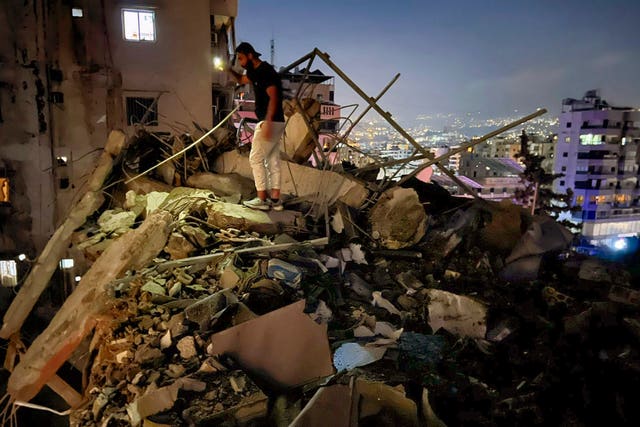
The strike hit an apartment building next to a hospital, collapsing half of the targeted building.

The hospital sustained minor damage, while the surrounding streets were littered with debris and broken glass.
Paramedics could be seen carrying several injured people out of the damaged buildings.
A forklift was in the middle of the street, reaching to the top floors of the destroyed building, while utility crews removed fallen power lines.
Crowds gathered to inspect the damages and check on their families. Some of them chanted in support of Hezbollah.
A resident of the suburb whose home is about 200 metres away said that dust from the explosion “covered everything,” and that the glass in his son’s apartment was broken.
“Then people went down on the streets,” he said.

“Everyone has family. They went to check on them. It was a lot of destruction.”
He spoke on condition of anonymity out of concerns about his security at a tense moment.
The National News Agency reported that the airstrike was carried out with a drone that launched three rockets.
The last time Israel targeted Beirut was in January, when an airstrike killed a top Hamas official, Saleh Arouri.
That strike was the first time Israel had hit Beirut since the 34-day war between Israel and Hezbollah in the summer of 2006.
Meanwhile, a senior United Nations official has appealed for the reopening of land crossings into the Gaza Strip and removing crippling restrictions on the delivery of aid to avert a humanitarian catastrophe in the war-torn Palestinian enclave.
Corinne Fleischer, regional director of the World Food Programme, said her agency has become unable to provide food rations in the strip since it does not have enough food inside Gaza.
“Right now the biggest challenge is we don’t have enough crossing points to bring the food in,” she told The Associated Press in Cairo.
“We need road access. We need the Rafah (crossing) to open again. We need Kerem Shalom to work better. We need law and order.”
The Rafah crossing, which had been the main entry point for humanitarian aid, was closed early in May after Israel’s military took over the crossing’s Palestinian side as part of its ground assault on Gaza’s southernmost city of Rafah.